

 … since your daughter died, you no longer have to anticipate grief…
I don’t remember exactly how she said it, but I do remember that she slipped the words in, seemingly unaware, during a meeting. They landed like an uppercut to the chin, and I was unsure of how to react. She thought her statement was full of obvious truth. Fact. She likely considered herself wise, and compassionate. After all, our life experiences in pediatric healthcare brought us together.
I tried to keep (more like regain) my composure. My partner and I, another bereaved mom, were onboarding another parent of a child with medical complexity and disability to our project training families as faculty in medical education. I was leading the meeting, and wondered, do I stop and gently correct her? The death of children in our community (and the grief attached) is not uncommon, but it feels like something people try to avoid talking about. Too close to home. Worst nightmare. I worried that things could go sideways. I did it anyway. I took a deep breath, gently raised my finger to catch her attention as she continued to talk, and watched as she finally stopped. “Could I respond to one of your thoughts?”
She nodded.
“You indicated that since my daughter died, I no longer anticipate grief. I, um, I just wanted to say that it’s not true. I still have plenty of anticipatory grief.”
“Well,” she said, her face revealing a bit of her internal scramble for the right words, “I mean that there is no more anticipatory grief because she is dead.”
I smiled, sort of, and maneuvered the meeting back on topic, realizing that a meaningful exchange was not to be had. In the days that followed, though, I could still feel the sting of the comment on my jaw. I raised my hand to rub it, trying to work out my discomfort and why I still felt it. I debated sending an email asking her to revisit the comment. And then I thought, turning in on myself, well, maybe she is right. So, I let it go.
In the past few weeks, the words from that meeting years ago have paced throughout the maze of my mind as the ninth death anniversary of my eleven-year-old daughter, Justice’,approached. She is dead. You know this. Back and forth. Justice is dead. Nothing to anticipate here. Zig, zagging through every thought. Nine years?
A familiar feeling of fear started to build up inside. We are getting too close to ten years gone. What if I forget her completely? Will this be the year I no longer feel the chub of her cheeks when I look at pictures of her smile? The year that I forget her laughter? That my memories blur?
Anxiety crept in, dragging a bit of depression with it and making me exhausted and weepy throughout the days. My heart joined along. The Takotsubo cardiomyopathy (also known as broken heart syndrome, a temporary condition triggered by extreme emotional experience) I experienced in the months leading up to the night she died returned. My ventricles felt like they were thrashing around while locked inside metal cages. I began a countdown to the anniversary. Eight days. Seven. Six. Five. The anticipation was killing me.
To ease my mind, I decided to look up the definition of anticipatory grief. Huh: The term is quite simply defined as “the process of grief, or mourning, before the loss”. In some articles it is described as “preparation” for the loss. Strictly speaking, the woman in my work meeting was right.
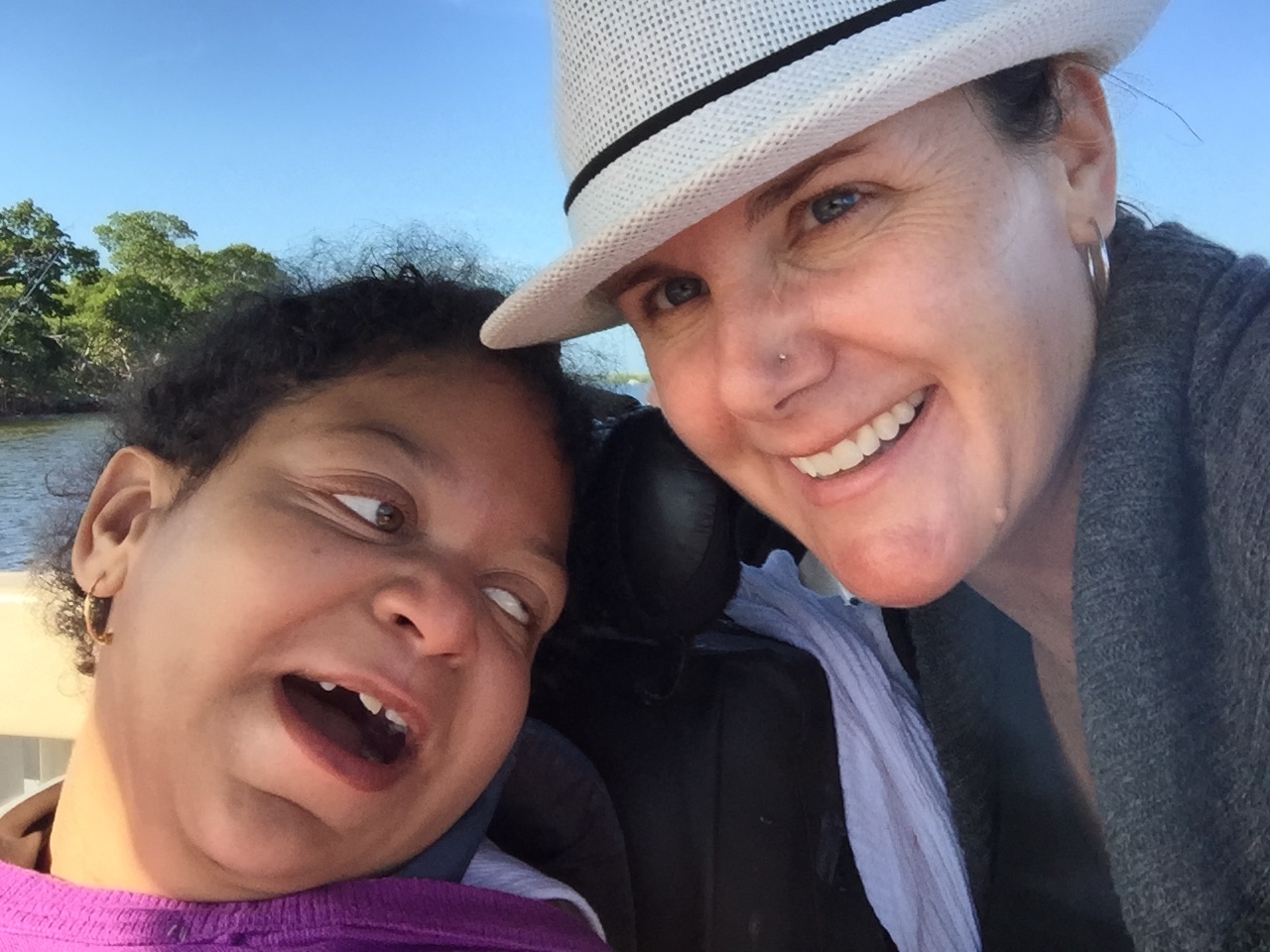
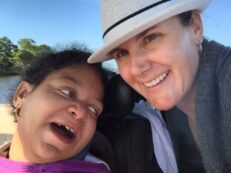
Cara and Justice on Sanibel Island, Florida, December, 2016 (image courtesy of the author)
Even though Justice was born with life limiting conditions, I never considered myself “prepared.” I had all the information— I worked in pediatric health care policy, research and education. I knew it was going to happen. I accepted it, adjusted to the fact that life would go on without her in it. And then she died. I moved into the pain of bereavement. But prepared? No.
The woman’s comment might have matched the standard definition, but it doesn’t feel that simple at all. My family still anticipates the ongoing grief about how she won’t be able to join pool time this summer. Or how she won’t tuck her wheelchair into the bleachers to watch her big brother’s return to basketball after injury, or her little brother’s high school debut. Or how she won’t be able to help her sister pick out a sparkly prom dress. We anticipate those phantom memories that were never made because of Justice’s death.
The grief I continue to anticipate after Justice’s death is as present as the grief I anticipated before it. It’s not complex or chronic. It’s as dynamic as my beautiful child — something to be cherished, felt, held and acknowledged. For the rest of my life, I will have to prepare to lose her over and over again.
Cara Coleman is principal at Bluebird Consulting and Executive Director of the Bluebird Way Foundation, a 501c3 in honor of and carries on the work of her daughter, Justice Hope, by using the arts, humanities, storytelling and narrative medicine to humanize health care and health profession education.