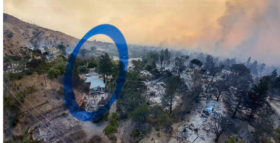
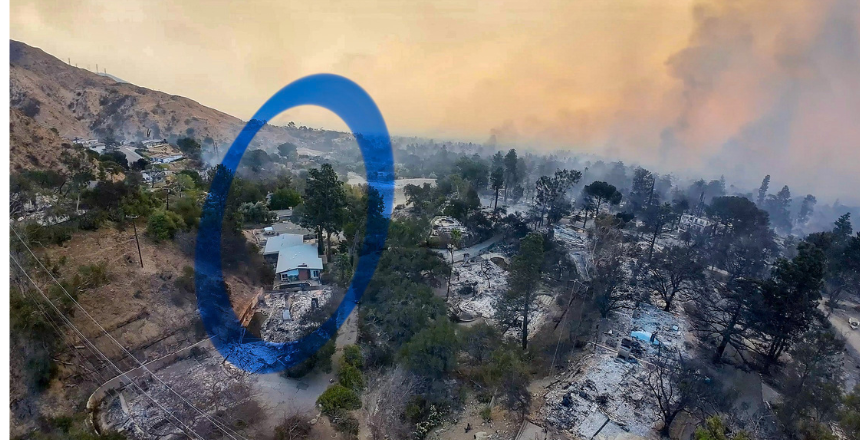
Most everything burned around the author’s home. (Photo Credit: RB Hopkins)
One year ago, as the sky glowed red and one-hundred mph winds roared around us, my husband and I packed up whatever we could fit in our car and said goodbye to our beloved home in Altadena. We evacuated to Echo Park, where we watched the Eaton fire from afar devour the mountainside until it became apparent that our neighborhood would be consumed. Thank God for Xanax.
In the end, 9,413 structures burned all around us, including the majority of our neighbors’ homes. Somehow, even though the paint on the exterior walls bubbled up from extreme heat, our home was still standing. It was, as we were told time and time again, a miracle. We were lucky.
Here is my uncomfortable truth: I’m tired of being told that I am so lucky my house didn’t burn down.
Don’t get me wrong, I do feel lucky. I also feel devastated that Altadena, our community, will never be the same. The individual and collective loss of life, homes, livelihoods, and history are impossible to quantify. And yet, almost everyone tries to categorize my loss by telling me to feel lucky.
I hate hearing lucky, because every time someone says it, I can feel them writing me off. As though I don’t need any more support: My home didn’t burn, nothing physical disappeared, so things are fine, right?
I hate hearing lucky, because every time someone says it, I can feel them writing me off. As though I don’t need any more support: My home didn’t burn, nothing physical disappeared, so things are fine, right? The same people who tell me how lucky I am are the ones who are shocked when they find out that a year after the fire it’s still not safe to return home. Why? The joys of bureaucracy!
The first time I met my State Farm insurance adjuster he aggressively screamed at me, “You should feel lucky!” When I pushed back, he called my loss “invisible.” Even though our home clearly had smoke and ash damage everywhere inside. Our insurance company saw our loss as an opportunity for negotiation. Not something cut and dry. Thus began a yearlong struggle to define our loss. We evaluated every item in our home: Is it toxic? Can it be cleaned? Will it be safe? Everything must be categorized, cataloged and quantified. All losses must be approved and valued. Putting a monetary value on our belongings and not on their emotional value makes these losses feel more invisible.
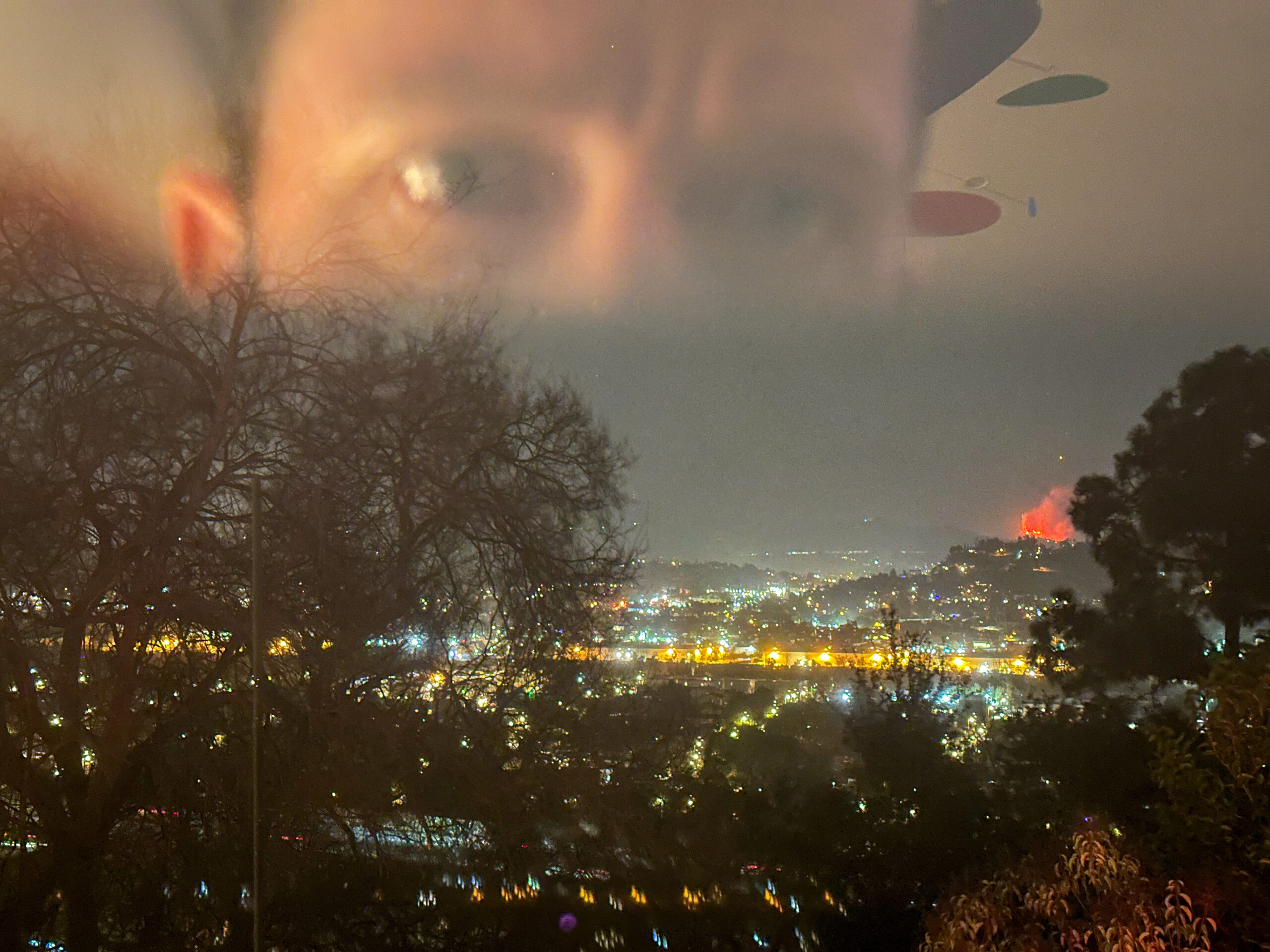
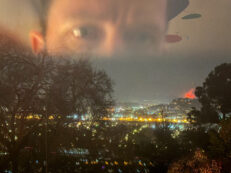
Nick watches the fire march toward his neighborhood after evacuating on January 7th, 2025
Those whose homes burned down to nothing know where their physical losses start and end. Those of us with smoke, ash, and toxic contamination can’t quite put a pin in the location and timeline of our own losses. And we feel shitty complaining about it because, after all, we do at times feel lucky. I frequently remind myself that nobody wins when comparing losses, but does anything good come out of silence? We in the smoke and ash category are the ones who are disenfranchising our own grief, feeling like we don’t have the right to the same space of grief as those who lost everything.
When your loss is a big grey area and everything is a negotiation, grief becomes nebulous as well. Ambiguity reigns. And when the loss seems inaccessibly hard to define, it’s difficult to start grieving, and a challenge to have anyone else actually acknowledge said loss.
When your loss is a big grey area and everything is a negotiation, grief becomes nebulous as well.
It’s been a year, and my home is a time capsule of grief. Dishes piled in the sink on January 7, 2025 are exactly where they were left. The mail from that day still sits on the counter. It feels like it’s been a year with my life on pause. The little stuffed animal I gave my late partner before he passed away in 2019 sits on a shelf.
Before, when I was missing him, I’d pick it up and carry it under my arm while doing things around the house. Now, it smells like smoke and is covered in a faint layer of black dust. The dust sparkles when light hits it, a telltale sign that there are high levels of toxic lead and metals covering everything. The stuffed animal still sits there. I am afraid to touch it. I know it will most likely end up in the trash. I sit with unrealized loss.
Ambiguous loss offers little understanding, lingering questions, and very few answers in sight. These are not just year-old wounds of grief and trauma, they are wounds that are still open and now infected.
Not burned down does not equal fine. Not a total loss still means loss. And there are losses so subtle and quiet that they will always be invisible to the outside world. Still, I keep thinking that my late partner’s clothes can be salvaged and cleaned. But then I’ll lose his smell.
Nick Stentzel, a California native and Altadena resident since 2013, is a certified Grief Educator and grief coach focusing on widowhood. He also serves as a group facilitator and journey sitter, supporting individuals through transformative experiences.