
 A week after my mom died from a long battle with breast cancer, my dad called in a grief consultation. Not with a rabbi. With a priest.
After years of living in Boston for many years, my Jewish parents had developed an odd fascination with the Catholic Church, the way some people follow the British Royal Family.
So there we were, in the backyard of my house in Cambridge, sitting across from a slightly rotund priest with a thick Boston accent.
He leaned in: “So do yah have any regrets?”
“What?” I didn’t understand the question. I’m twenty. This was my first real loss. I didn’t know what “forever” meant yet.
He clarified: “How was your relationship with your mother?”
I took stock. Three years earlier, before her diagnosis, I would have said “our relationship was hard” or maybe just “not good.” Plenty of mothers and daughters fight during the teen years, but ours was a little extra. It was hard for us to talk about anything without a fight. If I bought clothes from a thrift store, she’d say: “Dead people wore those clothes!” They were a slap in the face to her; she hadn’t been able to afford expensive clothes when she was a kid the way I could.
We were different in most ways. She was sophisticated; I was silly. School came easily to her; it didn’t to me. It was a recipe for deep disappointment in me as an unexceptional child. As I got older, I stopped absorbing her nitpicking and the fighting started. It never stopped.
Then my dad told me she had metastatic cancer and might not survive the week. She miraculously responded well to chemo, and I took it as my second chance to be a better daughter. I stopped fighting with her.
So I answered the priest’s question confidently. “I think our relationship was pretty good. We stopped fighting three years ago, when she got her cancer diagnosis. Right, dad?”
My dad didn’t need to take stock. He already had an answer. “Well, Father, I don’t know if “good” is the word I would use. Maybe “superficial” is more accurate.”
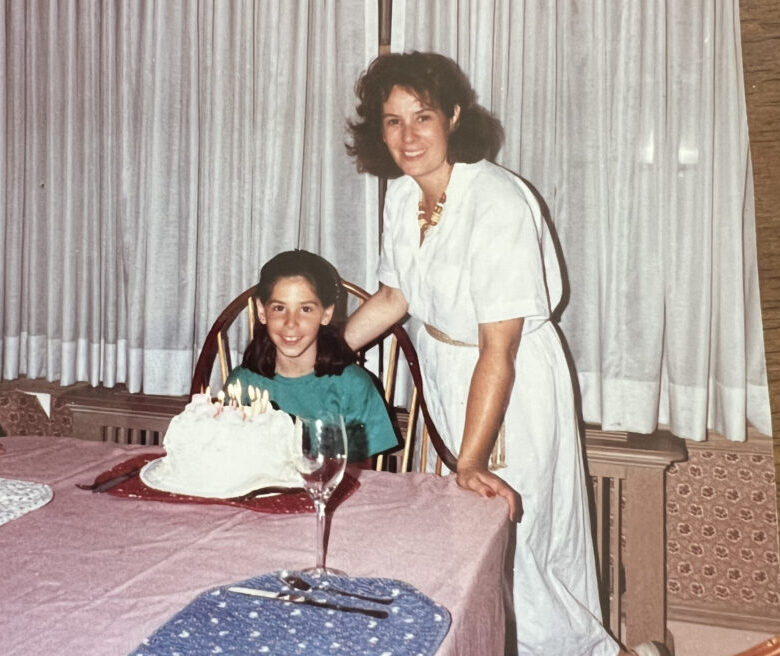
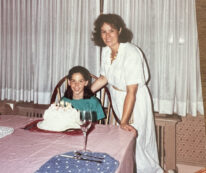
Together at Dara’s 8th birthday
Superficial?? We weren’t in a good place? But I had been so good with her. What could I even do now? She was dead.
He was right, of course. After she got sick, our conversations stayed on the surface, because going any deeper risked hurting each other. My parents had also built a wall around her illness to protect us, which meant I never felt invited to be “in it” with her. So instead of showing up for her, I focused on making her proud, doing well in school, which only widened the distance between us.
I spent the next twenty years carrying guilt and shame that I hadn’t fixed our relationship in time. My anger at things she’d said and done never fully left either, and it fed the guilt further. I didn’t have a name for it yet, but my grief was complicated. I loved my mother, but I also carried resentment that tainted the loss and confused the mourning. How do you fix a relationship that’s over?
A friend suggested I try a medium. “It really helped me find peace with my mother.”
How do you fix a relationship that’s over?
Why not try? On a 10-point scale between an atheist to woo woo, I’d put myself around a 7.5. I can’t fully commit to the cosmic realm, but when presented with it, I’m always game. And the idea of getting healed while lying down and doing nothing sounded a lot more appealing than the alternative: therapy, which is exhausting.
During the session, the medium called in my mother. I felt her presence, and also, overwhelmingly, my anger toward her. So much anger that that medium ended the session early.
“I don’t think this is a good time for you to connect with your mother,” she said, “I’m going to send her off with her ancestors.” I pictured my mom getting swept off into darkness with a bunch of old Jewish ladies.
After my failed trip to the spirit world, I turned to actual experts and found a grief therapist.
“Dara,” she said, “It might be time to accept that you might never come to peace with your mom. And that’s okay. You can stop beating yourself up about this.”
At first, relief. There was nothing I could do, so I could stop trying. Then almost as fast: hell, no! I’m not spending the rest of my life carrying this shit.
So I got to work. EMDR, self-help books, mindfulness practices aimed at self-compassion. And it worked. The compassion I learned to have for myself led to compassion for her, and I was finally able to let go of the anger, the guilt, the shame, the sense that I hadn’t been enough. Now I can grieve my mother, and the relationship I wish we’d had, without holding either of us to blame. We were both doing the best we could.
Is it possible to make amends with someone after they’ve died? I’d say yes. I thought our relationship ended when my mother died. I’ve since realized it’s still very much alive, which means it can still change. Which means I can still make it better.
Dara Kosberg is the Sr. Program Director at Reimagine and a storyteller, writer and comedian who recently performed her solo show, Homecoming, at the Hollywood Fringe Festival. Upcoming performance of Homecoming in Venice Beach on August 1