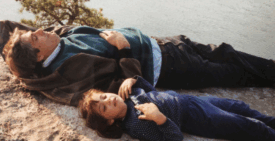



Romy Reiner with her parents, Rob and Michele (Instagram)
Like so many of us, I haven’t stopped thinking about Rob and Michelle Reiner since the news broke. But some details demand more than acknowledgment: that she was the one who found them. That she was just twenty-seven. Those facts rose into a howl I felt obligated to answer. I was twenty-seven when I found my mother murdered.
The day after, I imagined scuff marks on my eyeballs. I checked the mirror, studying my irises. Nothing. And also everything. You don’t see something like that without damaging your sight.
A week later, I was laughing—drunk at my mother’s wake—watching my friend put on a girl’s jacket and perform Chris Farley’s fat guy in a little coat in front of a bonfire. My brother and my grandmother were swing dancing, their faces locked in matching expressions of joy and disbelief, doing a thing they never imagined they’d do, and never would again. Another friend picked up my dad’s guitar and started singing “Closer to Fine.” I took the high harmony, she took the low, the way we used to in high school.
Anyone driving past that backyard bacchanal would’ve thought we were a pack of gluttonous lucky ducks. They wouldn’t have known that hours earlier, my brother had to peel me off my mother’s coffin because it had finally sunk in that she was inside it. They wouldn’t have known that my grandmother—pupils narrowed to pinpricks—had balled her fists and marched up to a stranger at the funeral, ready to punch his lights out after someone mistakenly whispered that he was The Prick Who’d Fired Debbie—the man she believed set off the spiral of drinking and despair that left my mother vulnerable to the man who moved into her home and eventually killed her.
The next morning, I woke up obliterated by a hangover. Feverish, head pounding, I stumbled into the living room and found my father passed out on the couch. It was July. The air was hot and stagnant. I stood there alone with him—the one who was left. The one who had cut me to the core my entire life and also taught me how to laugh, tell stories, and sing. The one my mother had always been there to help me make sense of.
My father stirred on the couch and we looked at each other. He squinted and said, “I lost a contact.” I poured solution into a lens case and got on my knees, combing the carpet. After I found it, we drank water. He hugged me goodbye, promising to see me later. I don’t remember what we said, but I imagine he asked into my hair, Are you going to be alright, darlin’? And I said yes, because I always had to be. When he left, I thought only one thing: I want it to be years from now.

The author one year after her mother’s murder. She was not “fine.” (Photo courtesy of Erin McReynolds)
Romy Reiner and I couldn’t have lived more different lives. Her parents were still married. She wasn’t left alone night after night as a child, teaching herself how to sleep through fear. She didn’t grow up managing adult chaos before she could legally drive. But perhaps, like me, she carried a bone-deep knowing that something devastating was coming. A sense that a seed had been planted long ago, buried in the family skin, that might one day break the surface.
When that kind of knowing comes true, it can feel mystical. I mistook it for supernatural ability. Purely by instinct, not reason, I believed that if I seduced my mother’s mortician, it might bring her back to life. I didn’t think this so much as feel compelled by it. Anyway, it didn’t work.
I was twenty-seven when I found my mother murdered, and I assigned meaning to that, too—the whole 27 Club mythology. Later, I learned it marked the beginning of a Saturn return: a three-year passage where adolescence burns off and adulthood is forged. A pressure cooker that tests who you are and deepens who you’re becoming.
At the end of that passage came the trial. I was more unhinged then than I had been in the immediate aftermath of the murder. I won’t say much more about it—it wasn’t my brother on trial, but a near-stranger. Romy, on the other hand, once called her brother her best friend. That is a different universe of grief.
Romy Reiner and I couldn’t have lived more different lives…But perhaps, like me, she carried a bone-deep knowing that something devastating was coming.
Still, my own grief is tangled with loving someone volatile and tormented, someone I feared might be at the center of a catastrophe that would ruin my life. That was my mother. So while it’s not the same, I can imagine what Romy is facing. And I hope she has the strength to endure it. I suspect she does.
The loneliest moment comes after the hubbub fades—after the funeral, after the casseroles stop arriving. When it’s just you and the road ahead. That’s when writers found me. Joan Didion taught me that you don’t need matching circumstances to feel seen. The poet undertaker Thomas Lynch made it possible to stand inside death without flinching. Anne Lamott gave me this: Grief ends up giving you the two best things: softness and illumination.
And one day, you get your wish. It is years from now. You look in the mirror and see what’s been etched into you: a reverence for laughter and rage alike, a lingering mysticism, a fierce capacity for meaning, and a tenderness that makes you intense, off-beat, too much, and exquisitely alive. Qualities that made the kind of life they would have wanted for you.
Erin McReynolds is a writer whose essays have appeared in The Sun, Kenyon Review Online, New Letters, and elsewhere, and were included as notables in Best American Essays 2020 and 2024. She writes and cartoons at www.traumafordummies.com.